
6.24.26 | Macarons Are Back
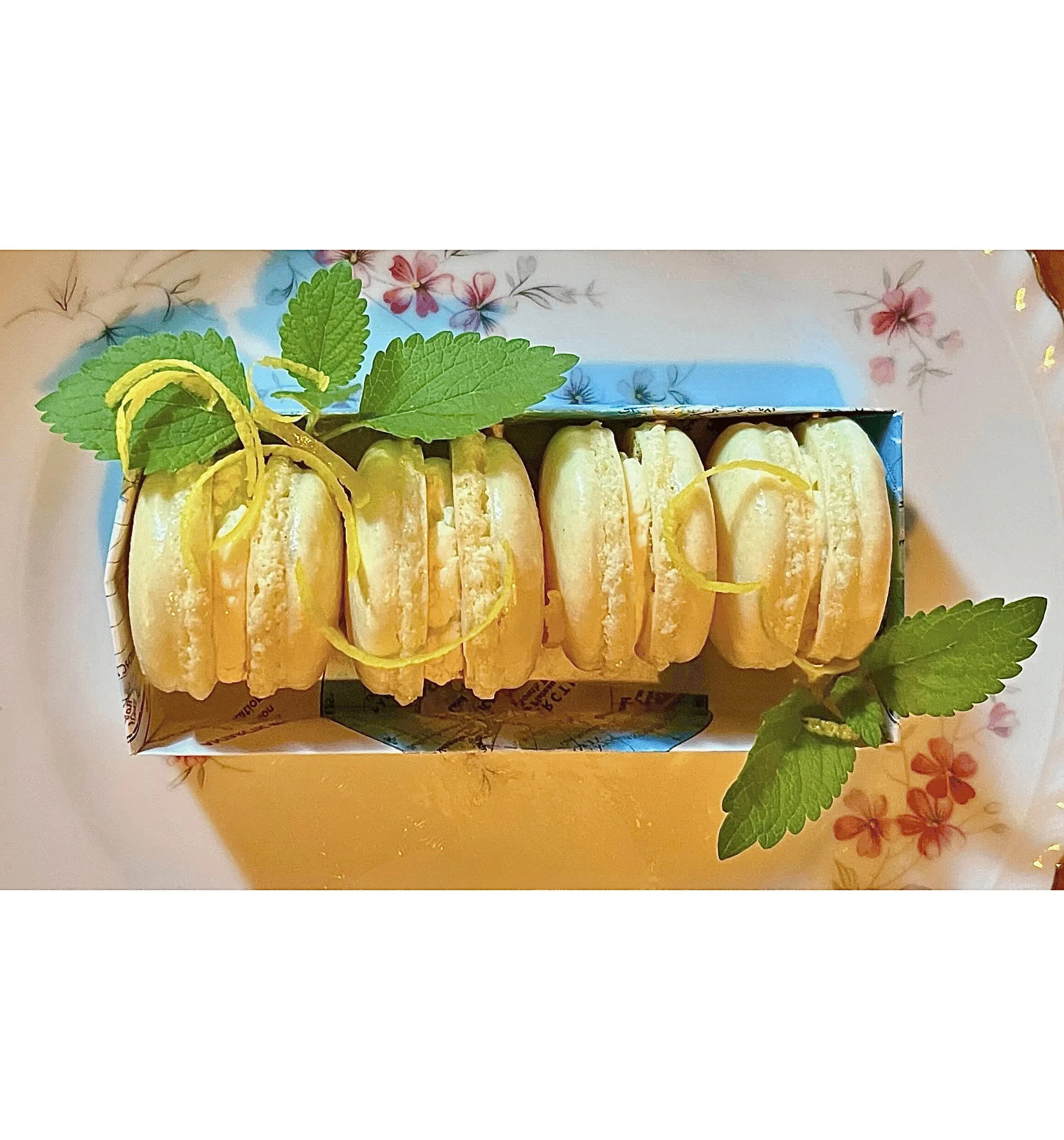
Over the last year or so, several folks have asked, "When are the macarons coming back?" And I often respond by saying that the weather isn't right for making macarons. They are quite finicky, and don't like humidity. The skins—the surface—of the macarons need to dry out in order to rise while baking. It's an important step to create the "foot" that is the signature of the macaron. The foot is the puffed ring at the bottom edge of the cookie. After a quick search using "macaron feet,” the computer returns a pretty great quote from Indulge with Mimi: “The presence, size and shape of macaron feet serve as a visual report card for the baker’s technique." I find it very cute that we give anatomical names to parts of baked goods.
But I had a thought the other day: What if I turn on our HVAC’s dehumidifier and get the humidity below 60%? Perhaps it's worth a try. And so, with the hygrometer at the ready, I went about doing a test run. It read 67% at the outset, and after a half an hour, it read 54%. Not bad! As you may have guessed, it worked.
The recipe I use was given to me by the chef that Matt and I worked for before we moved to Lexington in 2013. I'm pretty sure that he got it from a well-known French chef that he worked for at the early stages of his career.
As you will see, the simple ingredient list is not an indication of a simple method of preparation (or, as we call it in the biz, MOP). Quite the opposite actually. If I've gone a long while since making a batch, the first attempt often doesn't work out. It really is something that requires repetition before all the steps are mastered. I encourage you to try, though, because when it works out, it is oh so very satisfying.
Ingredients:
100 g egg white
230 g 10X (aka powdered sugar) divided in half
115 g almond flour
And now for the MOP:
1) Bring egg whites to room temperature, either by setting out for an hour or two, or placing in a warm water bath.
2) Triple-sift 10X and almond flour. (Though I am a little lazy and only double sift.)
3) Place half of the 10X aside for making meringue.
4) Combine other half of 10X and almond flour in a separate bowl.
5) Using a stand mixer, whip the whites until foamy, then gradually add 10X. Mix until you get stiff peaks. This is a stage where I often mess up. Because we are using 10X instead of granulated sugar, judging when the whites are stiff enough can be tricky. You may have seen folks turn the bowl upside down as an indication that the mixture is stiff enough, but I like to watch the whisk attachment the moment I turn the machine off. If the mixture is gathered around the whisk and doesn't move at all, you should be good to go.
6) Mix beaten whites into almond flour mixture. At this stage food coloring can be added. I am not a huge fan of food coloring because it often gives off a "fake" vibe that I don't like, and it changes baking times. However, for the lemon macaron I am using three drops of yellow. It's barely noticeable, but it is there—perfect. It’s easy to either under-mix or over-mix at this stage so determining this is all about paying attention to the "puddling" speed of the mixture. Not too fast, not too slow. This is the speed at which the mixture pools out after being piped. If you have over-mixed it will puddle too fast and the cookie will be too thin. If you have under-mixed the cookie won't puddle enough and the cookie won't form a smooth surface, and often the rise will be lopsided.
7) Pipe mixture onto parchment paper-lined baking sheets using a piping bag and a straight tip. Some folks use silicone mats with circles as a guide for the size of the cookie. I prefer to use parchment paper and just wing it when it comes to piping. Inevitably there is some variation in the size of the cookies, but it seems to work out.
8) Using both hands, lift the sheet pan up and tap on the counter several times to knock air bubbles out of the cookies. Then let sit for about half an hour.
9) Bake at 300 degrees until done, then cool completely on a rack.
10) I like to freeze macarons for at least 24 hours. I read in the Bouchon Bakery book that they actually develop more flavor with some time spent in the freezer. I find that puzzling, but also very cool, so I do it.
Then it is time to sandwich the cookies with whatever filling you may prefer. For the lemon macarons, I make a European buttercream and fold in lemon curd. The buttercream consists of Italian meringue that has butter whipped into it.
Then it's time to present them in a way that is appealing. I like them standing on their side in a row; it shows off their feet better. So I decided to build an origami box to hold them. I was given an origami book when I was young and was hooked immediately. At this point the process of folding the boxes is all muscle memory. I'm not quite to the stage of muscle memory with the macaron process but perhaps with more repetition I will get there.
In any case, both the folding of the boxes and macaron baking are gratifying endeavors. I wish you luck if you give them a go!
—Chef Becca